
Characterisation and Extension of a Rigid Body Dynamics Solver Coupled with OpenFOAM® for Flight Performance Analysis of Flapping-wing Drones
DOI:
https://doi.org/10.51560/ofj.v6.150Keywords:
Flapping-wing drones, Multibody dynamics, Articulated-body algorithm, Overset methodAbstract
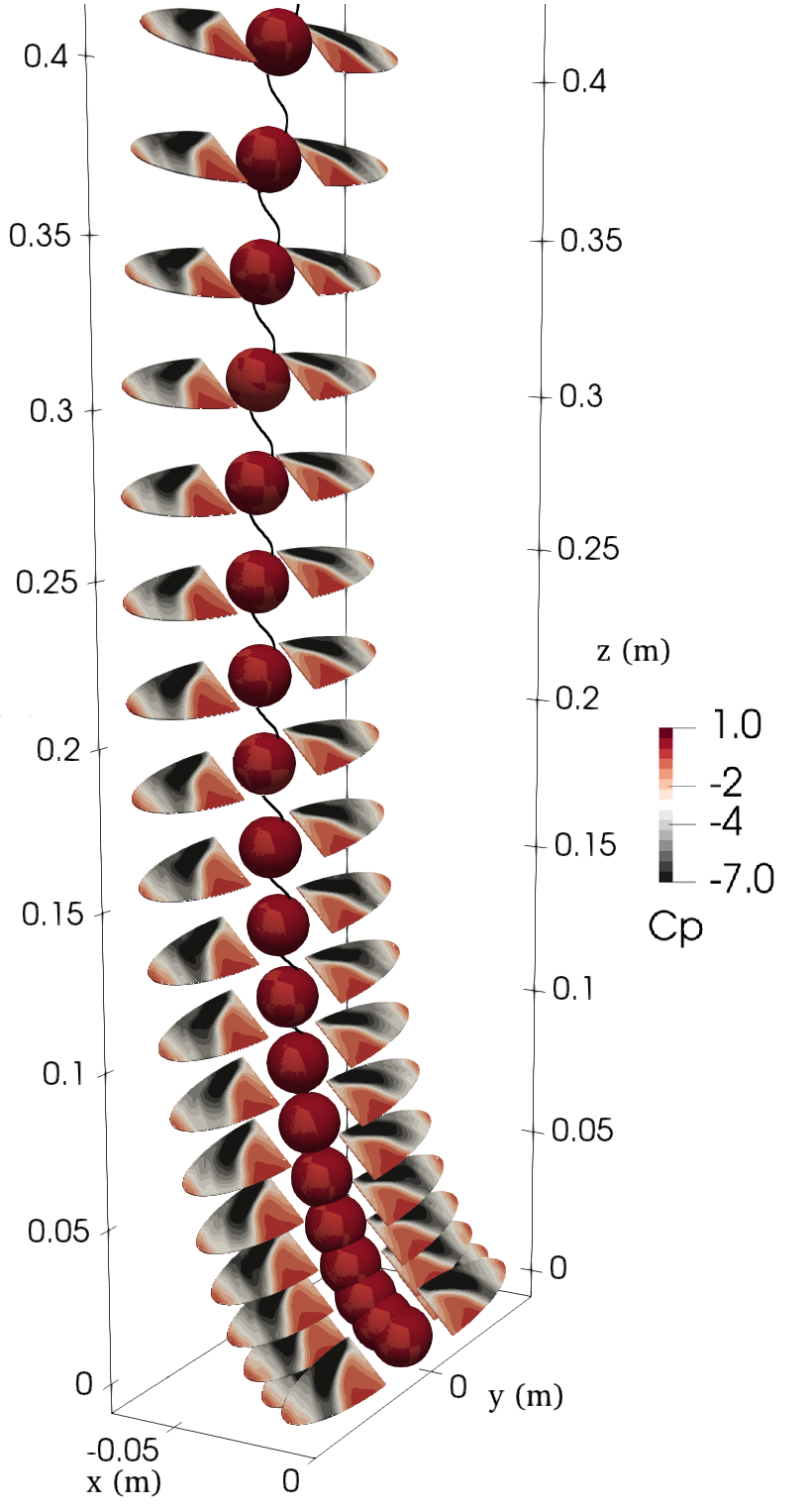
The extraordinary aerial agility of hummingbirds and insects continues to inspire the design of flapping-wing drones. To replicate them, computational fluid dynamics (CFD) simulations must be coupled with rigid body dynamics solvers. While OpenFOAM® provides a general articulated-body algorithm (ABA) for these multiphysics simulations, its current implementation is restricted to passive joints and lacks thorough verification for free-flight applications. This work addresses these limitations by introducing an extension of the ABA to support active joints with prescribed kinematics, allowing the body dynamics and the imposed motions to be solved simultaneously. The imposed motion is implemented in a new imposedMotion library that directly prescribes joint positions, velocities, and accelerations. The proposed approach is verified using a hierarchical strategy, including analytical benchmarks, comparison with quasi-steady aerodynamic models, and grid- and time-integration sensitivity analyses. Results demonstrate the robustness of the proposed framework and its ability to capture body–wing inertial coupling effects, contributing to the OpenFOAM® community with an extensible open-source platform for simulating partially actuated multibody systems in unsteady flows.
Downloads
Additional Files
Published
Issue
Section
License
Copyright (c) 2026 Romain Poletti, Emanuele Bombardi, Lilla Koloszar, Miguel Alfonso Mendez, Joris Degroote

This work is licensed under a Creative Commons Attribution-ShareAlike 4.0 International License.


