Steady RANS Modeling of the Atmospheric Boundary Layer: A Systematic Review and Some Practical Guidelines
DOI:
https://doi.org/10.51560/ofj.v6.166Keywords:
Computational wind engineering, Neutrally-stratified atmospheric boundary layer, RANS turbulence modelling, Horizontal homogeneityAbstract
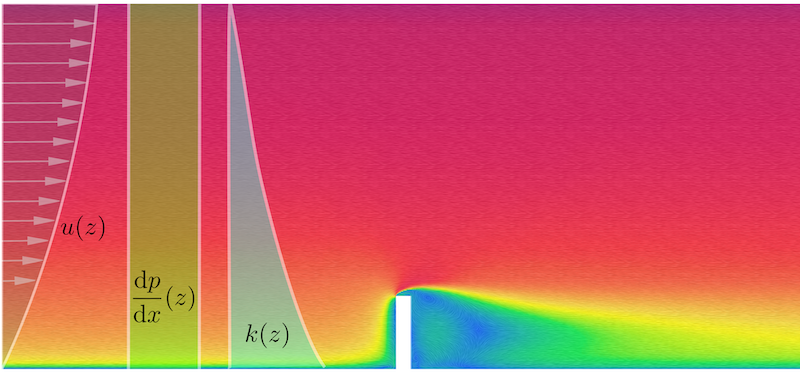
Accurate modeling of the neutrally stratified atmospheric boundary layer (ABL) is essential for computational wind engineering applications. The present study provides a comprehensive review of the ABL modeling approaches performed using Reynolds-averaged Navier-Stokes (RANS) equations. The main focus is on the different mechanisms used to drive the ABL flow and the corresponding boundary-condition formulations. Three major ABL modeling approaches were assessed, i.e., shear stress-driven, pressure-driven, and body force-driven flows, in terms of theoretical formulation, code implementation, and practical applications. The study addresses the role of the near-wall modeling, particularly the effects of wall functions that account for surface roughness using the aerodynamic surface roughness length and Nikuradse roughness parameter. A comparative analysis of these models is presented based on their ability to account for turbulence characteristics while maintaining the flow homogeneity. Computational simulations performed in OpenFOAM were used to assess the computational setup in these three approaches. This work generally serves as a guideline for selecting the most suitable ABL model for specific CFD applications, including urban wind studies, pollutant dispersion, and structural aerodynamics.
Downloads
Additional Files
Published
Issue
Section
License
Copyright (c) 2026 Ivan Batistic, Mihael Cindori, Severino Krizmanić, Ivo Džijan, Franjo Juretić, Petar Škvorc, Hrvoje Kozmar

This work is licensed under a Creative Commons Attribution-ShareAlike 4.0 International License.


