Implementation and Validation of a Three-Phase Phase-Change Solver with Merging Theory for Gas–Liquid Cavitating Flows
DOI:
https://doi.org/10.51560/ofj.v6.169Keywords:
Unsteady effects, Cavitation, Clark Y Hydrofoil, Merging theory, Air injection, three-phase flowAbstract
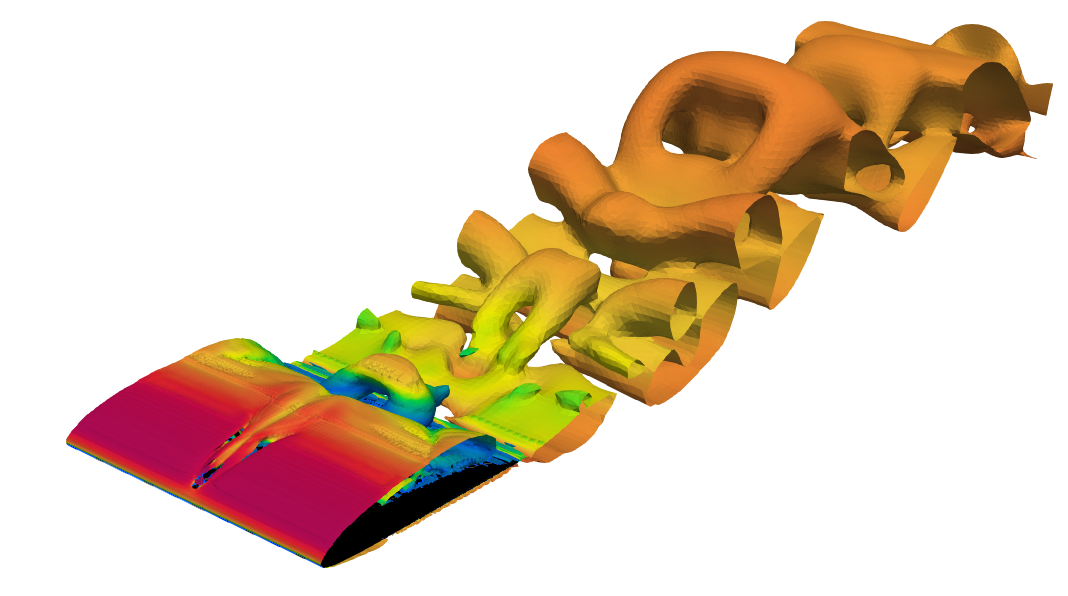
Numerical prediction of ventilated cavitation remains challenging due to the coexistence of liquid, vapor, and non-condensable gas and the strong unsteadiness of the resulting flow. This paper presents the implementation and validation of a three-phase VOF cavitation solver in OpenFOAM for water, vapor, and air flows, in which phase change is modeled only between liquid and vapor while the non-condensable gas is transported as an additional immiscible phase. To represent air-vapor coexistence effects inside cavitating structures, the solver incorporates a merging-theory-based effective pressure closure within a stabilized pressure and velocity coupling framework, together with bounded volume-fraction transport and mixture-density regularization to enhance robustness for strongly unsteady regimes. The solver is validated against published experimental measurements for a Clark Y hydrofoil with and without air injection. The results demonstrate that the implementation reproduces the reported mean pressure-distribution trends and captures consistent changes in unsteady pressure-fluctuation characteristics induced by ventilation. Overall, the proposed open-source implementation provides a numerically robust platform for simulating three-phase ventilated cavitation in configurations relevant to engineering applications.
Downloads
Additional Files
Published
Issue
Section
License
Copyright (c) 2026 Mehrdad Kazemi, Nikolai Kornev

This work is licensed under a Creative Commons Attribution-ShareAlike 4.0 International License.


